
Starlink Mounting for Emergency Services
Reliable Starlink Connectivity for Emergency Response
Starlink for emergency services has to connect when the mobile network is down, wherever a crew is sent. Air Vision Systems designs Starlink mounts in NZ for response vehicles, rescue appliances, command units and the incident control point itself.
The Problem
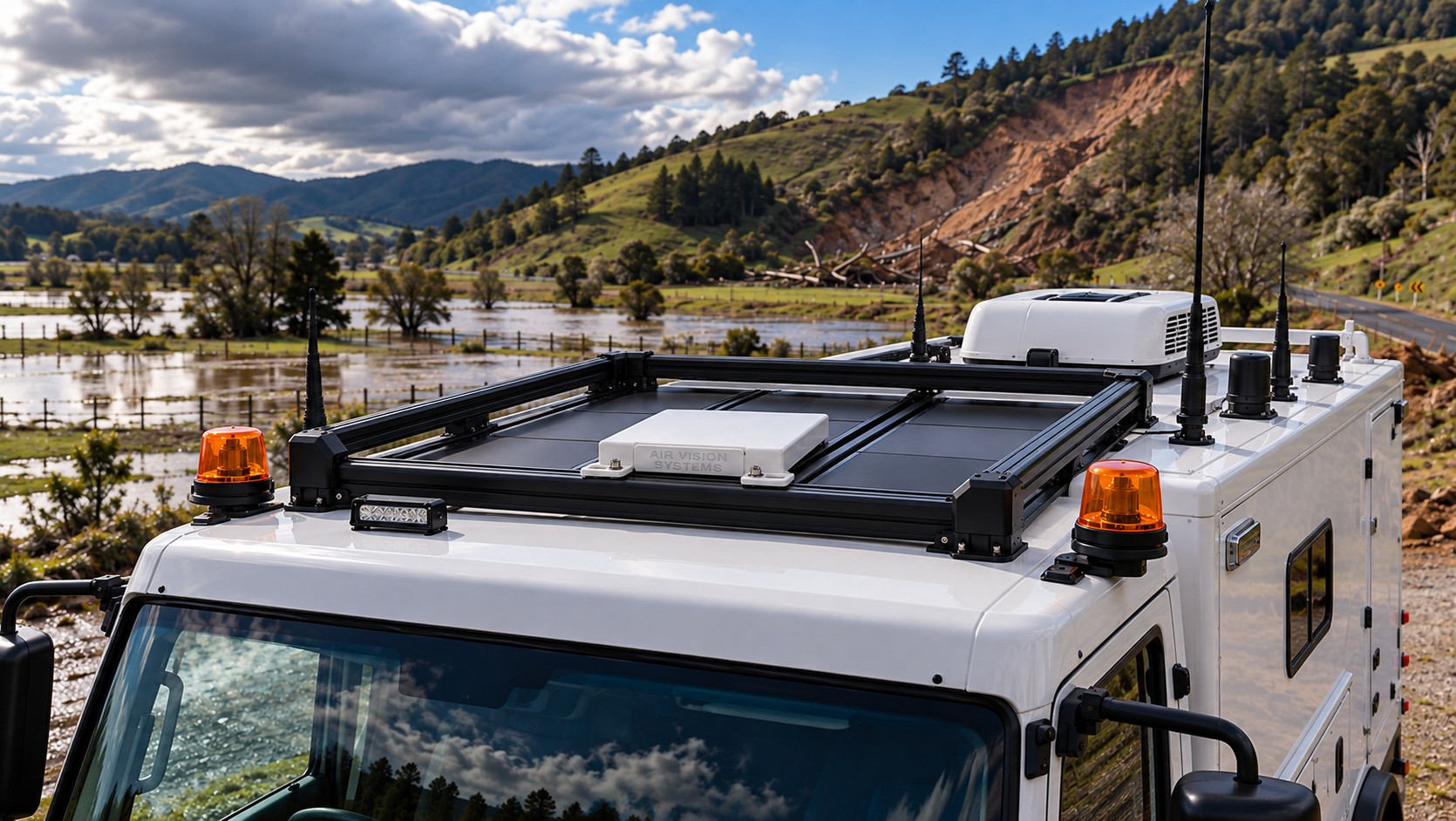
Emergencies are when the mobile network is most likely to fail. After Cyclone Gabrielle in 2023, about 80 per cent of cell site outages were caused by power loss, and most of the rest by lost fibre links, many of them cut by landslips and flooding. Crews were sent into areas where phones and internet had gone at the same time.
Even on an ordinary day, rural callouts take crews into steep country, back roads and coastline where mobile coverage is patchy. A response vehicle or command unit with its own satellite connection keeps incident management systems, mapping, video and messaging running wherever the job is. It adds to your radio network and emergency procedures; it does not replace them.
Emergency vehicles are also crowded on the roof. Light bars, sirens, beacons and aerials are already there, and the vehicle is driven hard. A mount has to fit around what is already fitted and stay put.
Can You Call 111 Over Starlink?
A Starlink dish does not give you a phone line or a 111 service of its own. It gives you an internet connection, and a phone connected to it can use Wi-Fi Calling. Some New Zealand mobile networks let a phone with Wi-Fi Calling switched on make a 111 call over Wi-Fi when there is no mobile coverage. Check with your provider that this works on your plan and your phones before you rely on it.
Two cautions. An emergency call tries the mobile network first and only uses Wi-Fi when there is no mobile signal. And a phone that is only connected over Wi-Fi does not receive Civil Defence emergency mobile alerts, so the crew still needs another way to receive them.
Recommended Configuration
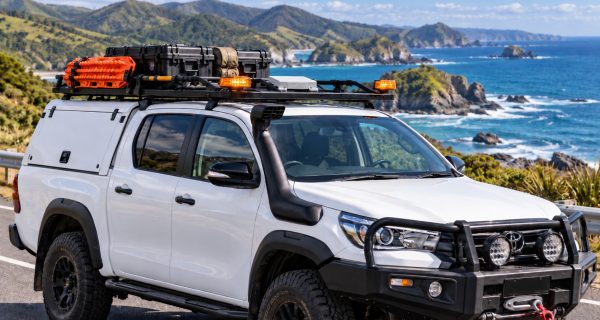
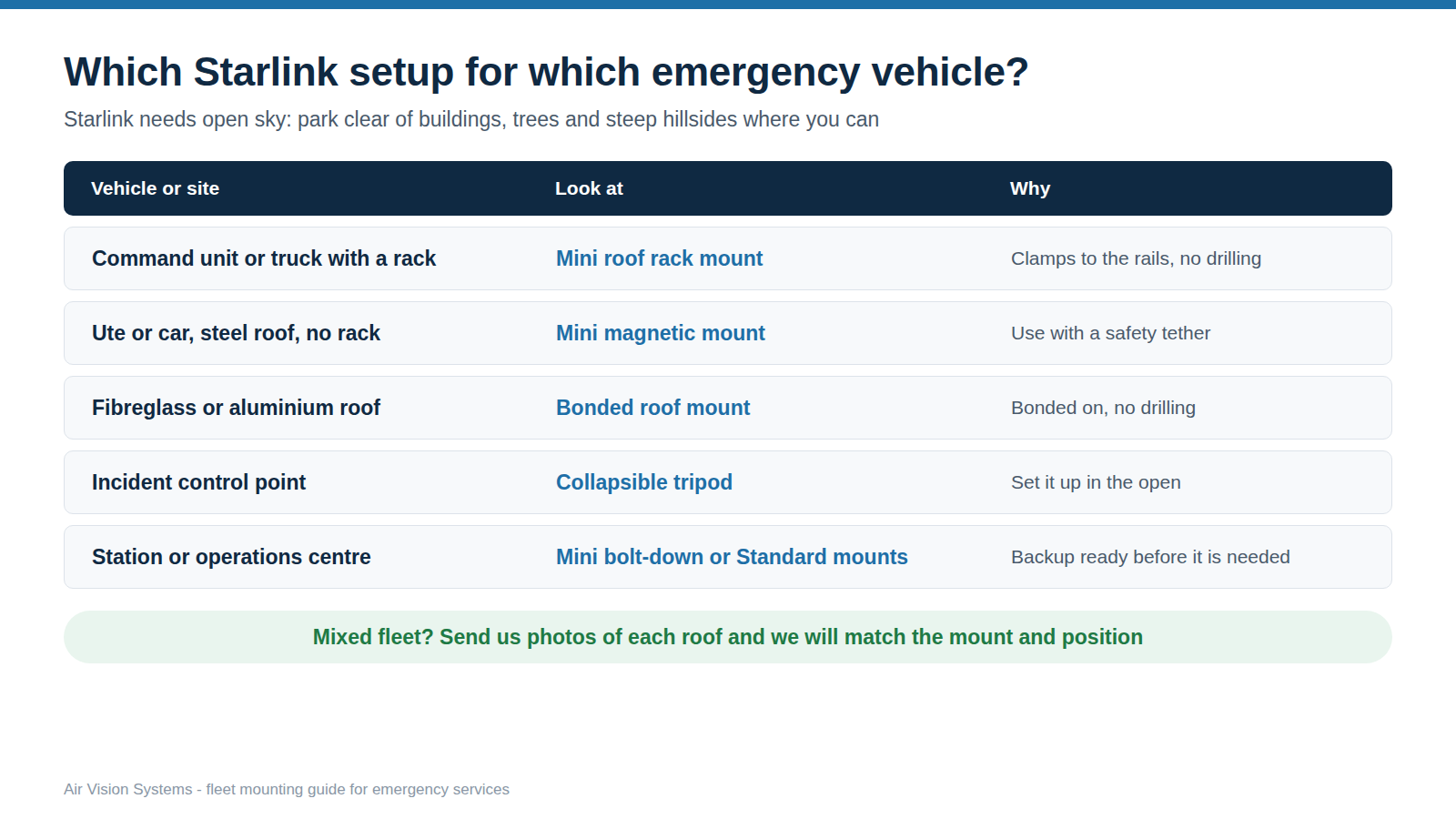
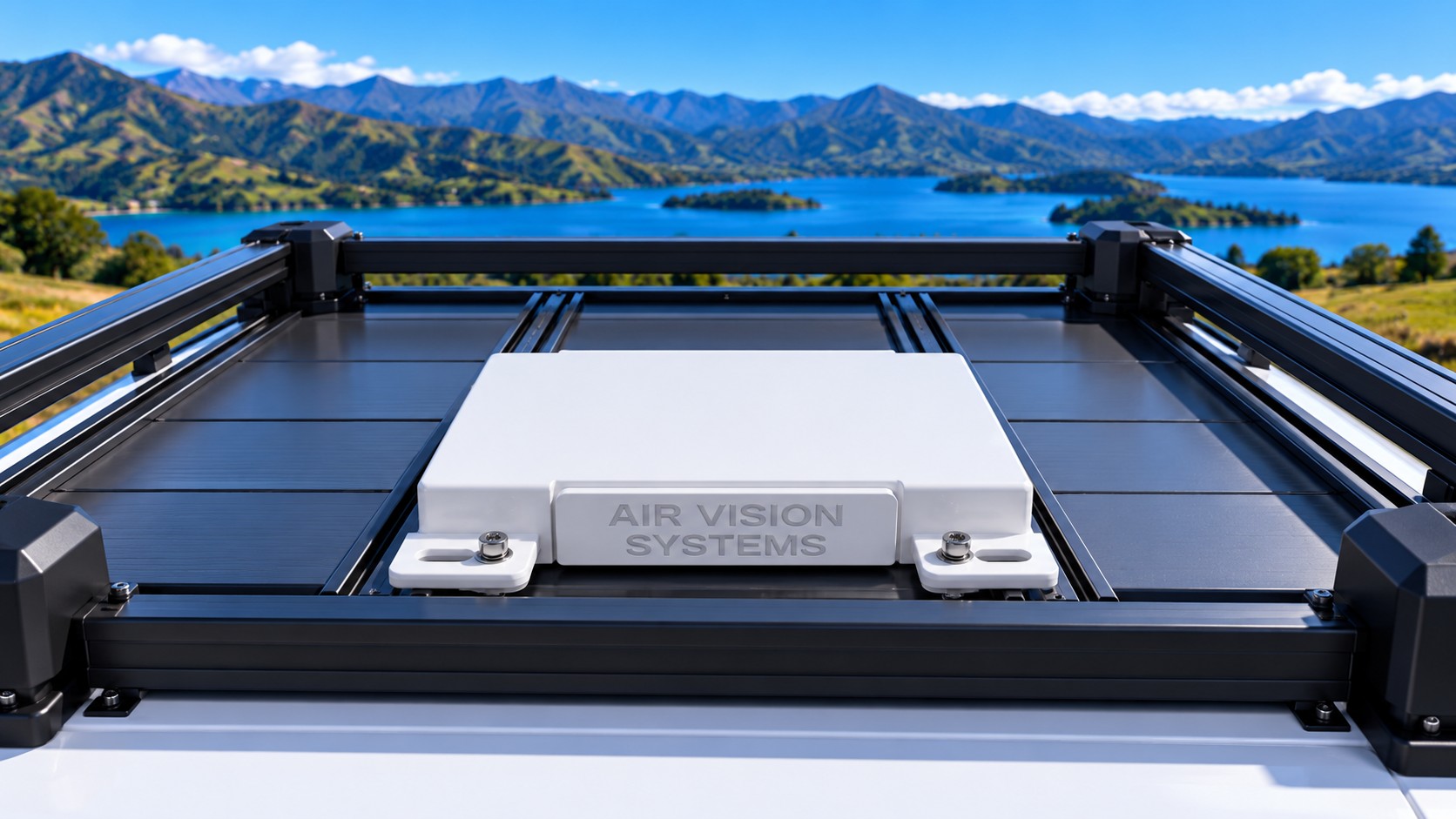
Command unit, rescue appliance or support truck with a roof rack
Clamps to the existing rails, so there is no drilling. Positioned clear of ladders, lights and aerials.
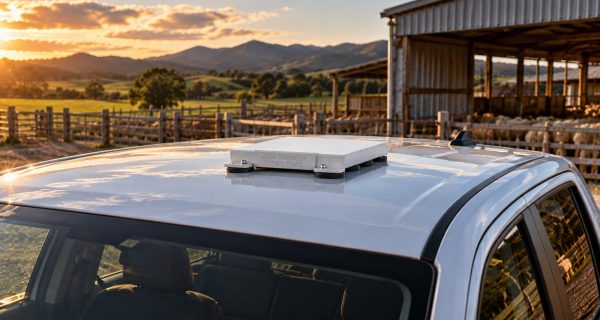
Response ute or car with a steel roof, no rack
Use with eight 66 mm magnets or four 88 mm magnets, plus a safety tether. Steel roofs only. Placed clear of the light bar and aerials.
Ambulance or other vehicle with a fibreglass or aluminium roof
Bonded to the roof, so there is no drilling, in a position your vehicle builder approves. Magnets will not hold on fibreglass or aluminium. We have fitted Starlink mounts to private ambulances.
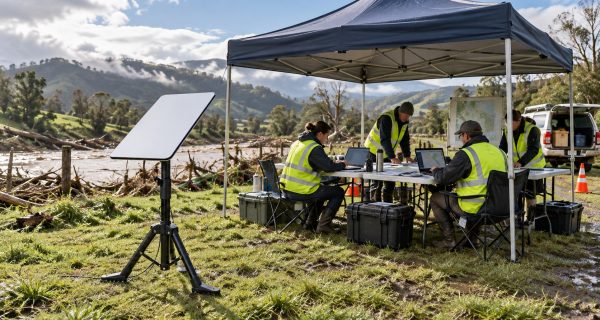
Incident control point, cordon or staging area
Up in minutes on open ground, and packs away when the response moves on.
Station, emergency operations centre, or welfare centre
A fixed backup connection that is ready before it is needed.
Power: the Starlink Mini runs from 12 to 48 V DC, so it can run from a 12 V or 24 V vehicle electrical system or a battery. The Standard kit runs from its own 100 to 240 V power supply, so it suits a station or centre on mains or a stable generator. We supply power solutions and extension cables to suit.
Technical Specification
| Item | Figure | Basis |
|---|---|---|
| Starlink Mini dish | IP67 Type 4 (with cables installed), -30 to 50°C, 1.10 kg. Built-in Wi-Fi 5 router, up to 112 m² and 128 devices | Starlink specification sheet |
| Starlink Standard (Gen 3 / V4) dish | IP67 Type 4, -30 to 50°C, 2.9 kg. Power supply 100 to 240 V, IP66. Router: current kits ship with the Router Mini (Wi-Fi 6, up to 204 m² and 235 devices); earlier Gen 3 kits came with the larger Gen 3 router (Wi-Fi 6, up to about 297 m² and 235 devices) | Starlink specification sheet |
| Starlink Mini bolt-down mount | Wind of 252 km/h, the threshold of a Category 5 hurricane, with the mount bolted to timber, steel and concrete bases | Computer simulation (airflow and structural) |
| Roof rack mount, two-rail | Wind of 252 km/h from five directions. Highest stress in the aluminium plate 16.2 MPa against a yield strength of 193 MPa: a safety factor of 11.9, and above 9 with an extra 25% allowance for gusts | Computer simulation (airflow and structural) |
| Materials | Marine-grade 5052 aluminium plates and brackets; stainless steel T-bolts on the roof rack mount: 316 on marine versions, 304 on inland versions | AVS design specification |
Mount figures come from computer simulation under defined test conditions. They support the design and are not a substitute for vehicle-specific, site-specific or regulatory certification. Figures for the magnetic mount, the bonded roof mount, the Standard mounts and the tripod are not listed here; ask us about your vehicles. See our engineering reports.
Installation Notes
01.
Existing equipment. Keep the dish clear of light bars, sirens, beacons and aerials, so it does not hide them or sit in their way. We agree the position with your fleet manager or vehicle builder at quote stage.
02.
Vehicle builders. Many emergency vehicles are fitted out by specialist builders to your organisation’s standards. Where that applies, have the builder approve or carry out the fitting. We supply the hardware and fitting details.
03.
Cabling. Bring the cable into the vehicle through a proper sealed entry point and secure it clear of doors, hinges and moving parts. Follow the vehicle’s existing wiring routes where you can.
04.
Power. The Starlink Mini runs from 12 to 48 V DC, so it suits both 12 V and 24 V vehicles. Use a fused supply; we confirm the right cable and fuse at quote stage. For long jobs with the engine off, plan for a battery or power station so the vehicle battery is not run flat.
05.
Magnetic mount. Steel roofs only. Place it on clean, flat, dry steel and always fit a safety tether.
06.
Sky view at the scene. Park with open sky above where you can. Buildings, trees and steep hillsides block the view. The Starlink app has an obstruction check that shows what the dish can see.
Compliance Statement
Air Vision Systems is a New Zealand-owned company and an approved supplier to New Zealand Police. Our mounts are designed in-house and assessed by computer simulation under defined test conditions. These assessments support the design; they are not a substitute for vehicle-specific, site-specific or regulatory certification.
Fitting a mount to an emergency vehicle should follow your organisation’s fleet fit-out standards and must not hide or obstruct warning lights, sirens or aerials. Your fleet manager should confirm each installation meets your own rules. Starlink is an extra layer of communication and does not replace your radio network, 111 procedures or emergency plans. Starlink supports the Mini in motion on eligible plans, where permitted (Starlink Help Center).
Get a Fleet Quote
Fast Response From Our NZ Team.
FAQs
Common Questions
Can you call 111 over Starlink?
Will the dish get in the way of the light bar or sirens?
Does the magnetic mount work on an ambulance?
Can the Starlink Mini run from a 24 V vehicle?
Does Starlink replace our radio network?
Can one order cover a mixed fleet?
What happens when a vehicle is replaced?
Roof rack and magnetic mounts can usually move to the replacement vehicle. A bonded mount stays with the roof it was bonded to, so the new vehicle needs its own.
We grow in a hail-prone area. Is there protection for the dish?
Yes. The Starlink Mini outdoor protective cover adds a hail cover over the dish. See our hail protection article for the details.