
StarLink V5
Starlink V5 Explained: Specs, Cables and Accessories
Starlink announced a new residential dish, the Starlink V5, in mid-July 2026. It is smaller, lighter and uses around half the power of the Standard 4 dish (the V4 dish many people still call Gen 3). At the time of writing it is only available in selected parts of the United States, but it is already raising real questions for New Zealand and Australian customers: will an existing cable carry over, will an existing mount fit, and when is it coming? Air Vision Systems has answered those questions from Starlink’s own specification sheets and published documentation, and this page will be kept updated as availability becomes clearer.
Choosing the Right Accessories for Your Starlink V5
The official 15 m and 45 m Starlink Cables are both confirmed compatible with the Starlink V5, matching the same official cables used for the Standard 4 and Standard 4X. For mounting, a customer with an existing 31 to 50 mm metal pole may be able to reuse it with Starlink’s own V5 pipe adapter; accessories built for the Standard 4 or Gen 3 dish shape should not be assumed to fit.
About Starlink V5
What Is the Starlink V5?
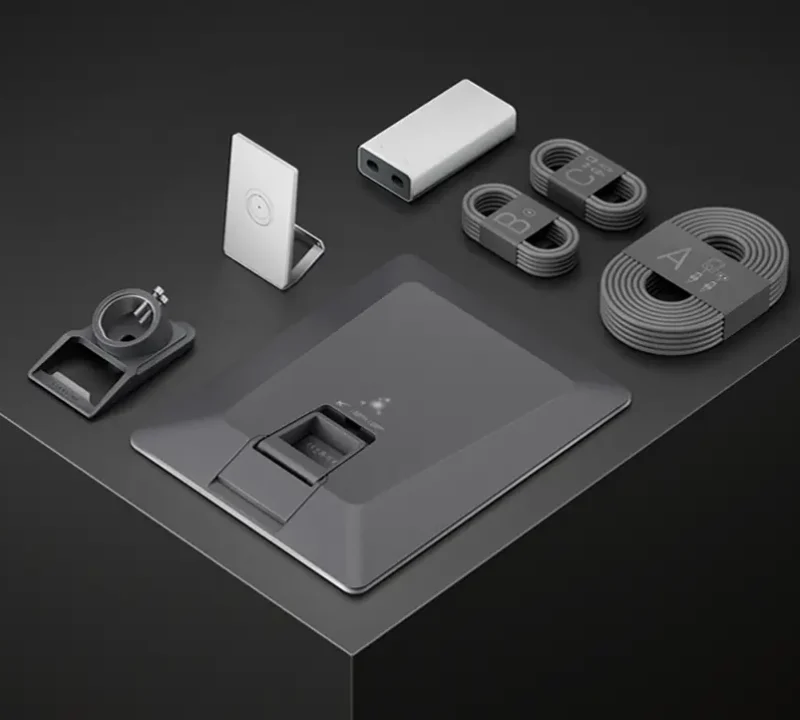
The Starlink V5 is a new fixed residential dish. It uses the same electronic phased array antenna technology and 110-degree field of view as the Standard dishes, but in a smaller housing with a separate external power supply. The kit contains the dish (fitted with a removable kickstand), a pipe adapter, a power supply, the Router Mini and its stand, a 15 m Starlink Cable, a 2 m Starlink Ethernet Cable and a 1.5 m power cable.
The most notable change is efficiency. Starlink lists average power consumption at 35 to 50 watts, well below the 75 to 100 watts of the Standard 4. That matters for off-grid, solar and battery-backed installations.
Starlink says the V5 is not intended for in-motion use, so it should be treated as fixed-install hardware. For in-motion installations, Starlink supports other hardware, including the Standard 4 and the Starlink Mini, subject to the service plan, region and installation requirements.
Unlike the Mini, the home V5 does not appear to have a satellite navigation (GPS) receiver. Independent research into Starlink’s firmware found none in the home version, which fits with Starlink’s statement that it is not intended for in-motion use. A separate automotive version of the V5 does have one; see the FAQ below.
Technical Data
Starlink V5 Specifications at a Glance
| Specification | Starlink V5 |
|---|---|
| Dimensions | 384 mm x 306 mm x 34 mm |
| Dish weight | 1.1 kg (2.4 lbs) |
| Kit weight | 3.8 kg (8.4 lbs) |
| Field of view | 110° |
| Environmental rating | IP67 Type 4 |
| Operating temperature | -30°C to 50°C |
| Wind rating (mounted) | Operational: 265 kph (165 mph) |
| Snow melt capability | Up to 40 mm/hour |
| Average power consumption | 35 to 50 W |
| Power supply | Separate unit, 157 x 74 x 36 mm, 0.40 kg, IP66 Type 4 with included cables installed |
| Included router | Router Mini (Wi-Fi 6, dual-band 2x2 MU-MIMO, two 1 Gbps Ethernet ports, indoor only) |
| Cables in the box | 15 m Starlink Cable, 2 m Starlink Ethernet Cable, 1.5 m power cable |
How the Starlink V5 Compares to the Standard 4
The dish itself is a genuinely different physical product from the V4 dish, not a rename. The table below compares it with the Standard 4, using both of Starlink’s specification sheets. The Standard 4X uses the same V4 dish with a different router, so the dish figures apply to it too. Starlink cross-lists the same official 15 m and 45 m Starlink Cables for the V5, Standard 4 and Standard 4X. Almost everything else, from the physical footprint to the power supply and mounting hardware, is different.
| Starlink V5 | Standard 4 (V4 dish) | |
|---|---|---|
| Dish size | 384 x 306 x 34 mm | 594 x 383 x 39.7 mm |
| Dish weight | 1.1 kg | 2.9 kg (3.2 kg with kickstand) |
| Average power draw | 35 to 50 W | 75 to 100 W |
| Wind rating (operational) | 265 kph (165 mph) | 96 kph+ (60 mph+) |
| Environmental rating | IP67 Type 4 | IP67 Type 4 |
| Power supply | Separate unit, 157 x 74 x 36 mm, 0.40 kg | Separate unit, 194 x 98 x 35.75 mm, 0.65 kg |
| Mount hardware included | Pipe adapter and kickstand in the box | Kickstand in the box; pipe adapter mount sold separately |
| Pipe adapter pole size | 31 to 50 mm, metal pipe only | 31 to 63.5 mm (Standard pipe adapter mount), metal pipe only |
| Dish cable | 15 m Starlink Cable (45 m also compatible) | Same 15 m and 45 m Starlink Cables |
Is the Starlink V5 Available in New Zealand and Australia?
As of 24 September 2026, Starlink is advertising V5 in selected areas of the United States and says it will reach additional areas as production ramps up. No V5 launch announcement or V5 ordering option has been found for New Zealand or Australia, and Starlink has not announced a release date for either market. Roam eligibility for the V5 has not been confirmed either. Checking availability for a specific address directly in the Starlink ordering flow is the most reliable source.
Last Update: 2026-09-29
WHICH SETUP DO YOU NEED
Find Your Starlink Mini Setup
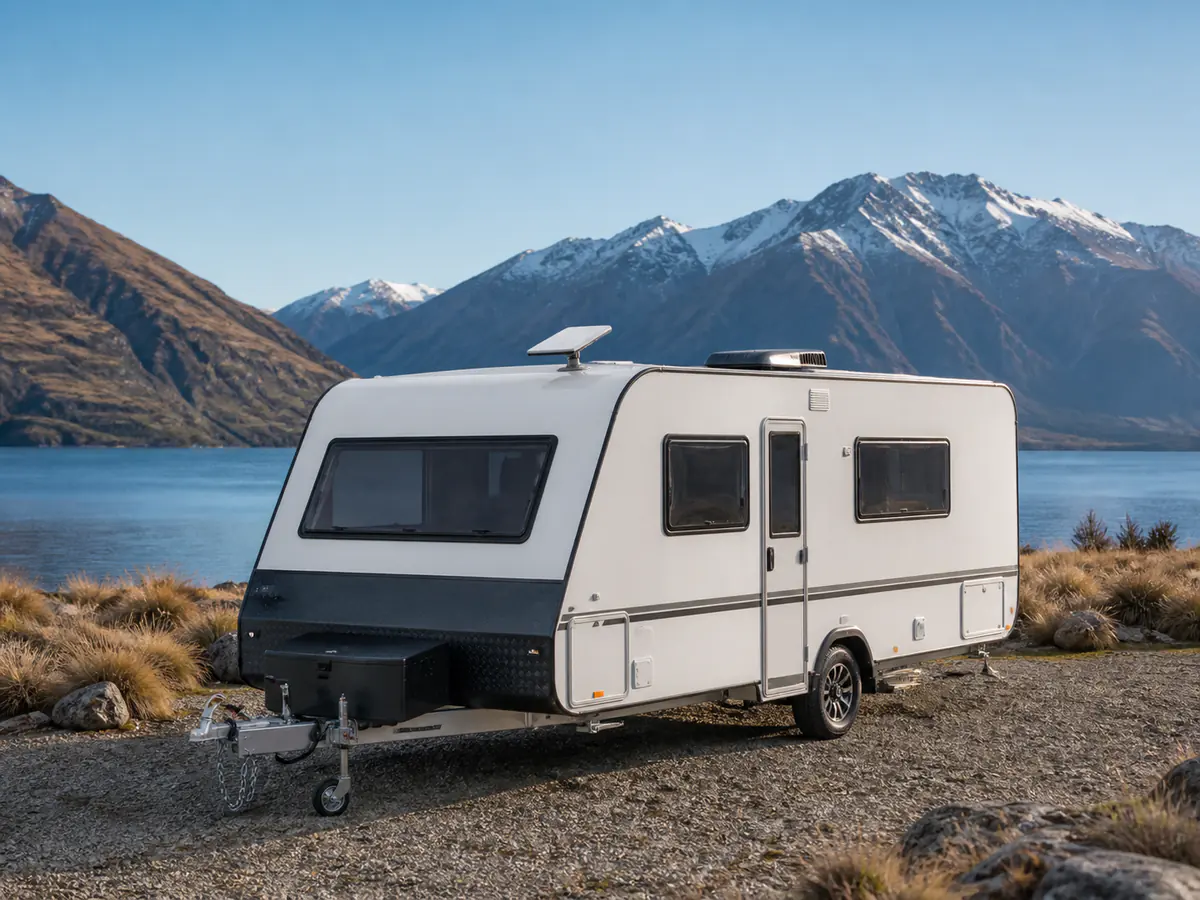
Vehicle
Mounts, power and accessories for reliable Starlink Mini on the road.
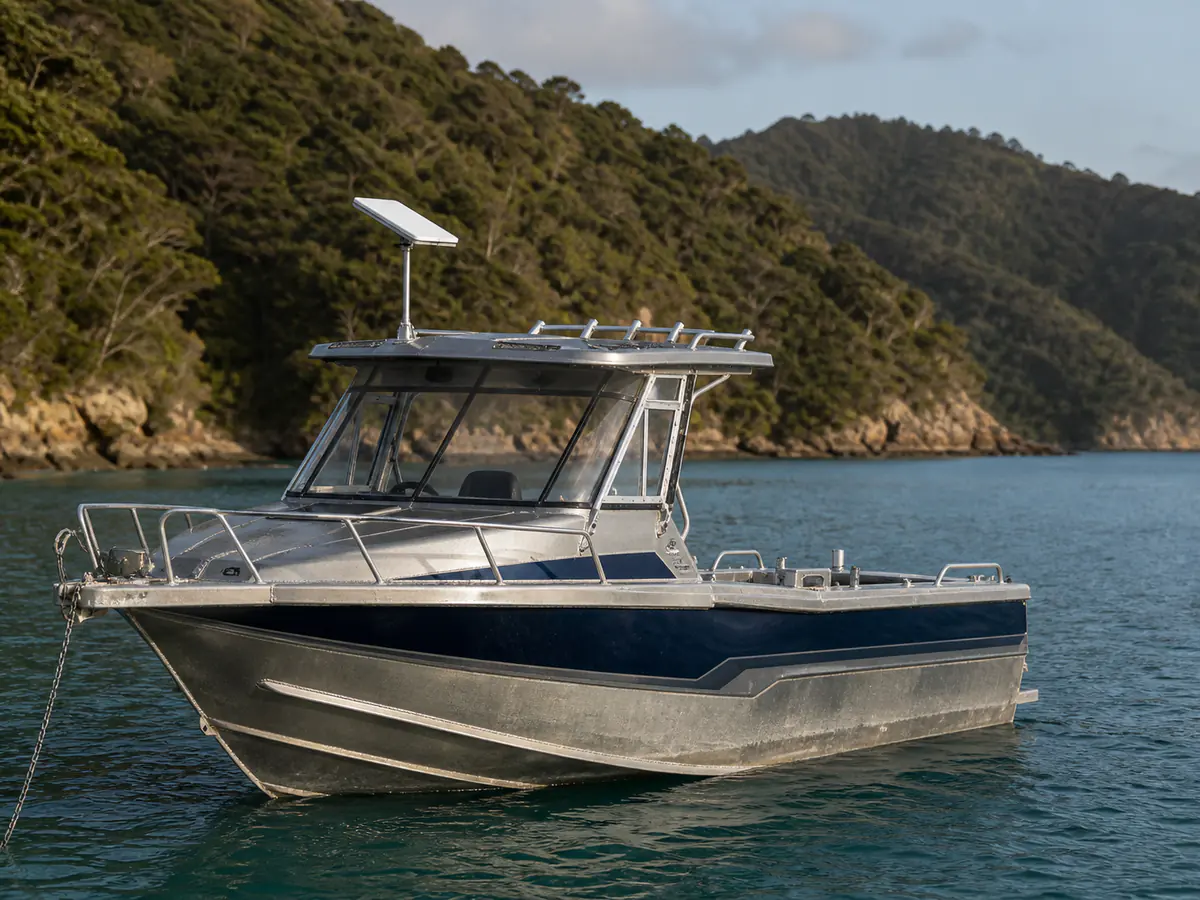
Marine
Marine-ready mounts and accessories built for reliable use on the water.
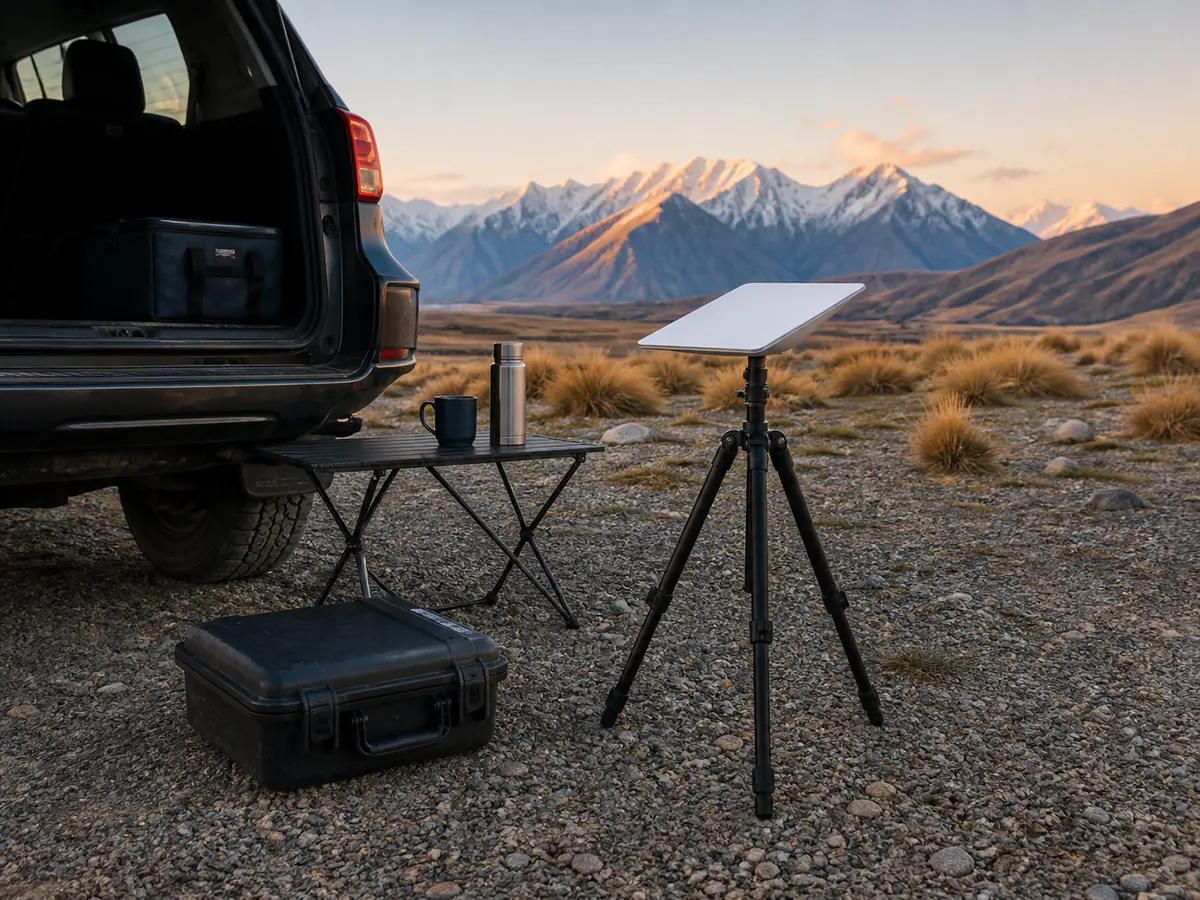
Portable
Compact, lightweight accessories for easy setup wherever you go.

Fixed Setup
Reliable mounting, power and protection for permanent installations.
Will My Starlink Cable Work With the V5?
This is the question Air Vision Systems customers ask most. Starlink’s own documentation answers it for the dish cable: Starlink lists the same official 15 m and 45 m Starlink Cables as compatible with both the Starlink V5 and the V4 dish, which is sold in two kits, the Standard 4 and Standard 4X. It is the same official cable for both dishes. Every figure on this page comes from Starlink’s own published documentation.
Dish cable, 15 m
Confirmed. Starlink lists the same 15 m Starlink Cable for the V5 and for the V4 dish, used in both the Standard 4 and Standard 4X kits.
Longer cables, 45 m
Confirmed. Starlink now lists its official 45 m Starlink Cable for the V5, as well as for the V4 dish in the Standard 4 and 4X kits. The 15 m cable remains the only one supplied in the V5 kit.
Mounts and covers
Different. The V5 dish is a different size and shape, so Gen 3 mounts, pole adapters and protective covers are not expected to fit without a dedicated V5 version.
Power supply
Different. The V5 ships with its own smaller power supply. Starlink’s current public V5 specification sheet gives its dimensions, weight and environmental rating but does not state the DC output rating. A Standard 4 power supply, PoE injector or 12 V conversion kit should not be assumed to run a V5 until compatibility has been confirmed.
Starlink Mini: different cables
The Mini is powered through its own DC cable, not through a dish cable. For a wired connection, Starlink supplies a separate Mini Starlink Ethernet Cable with a standard RJ45 plug at the router end. Starlink does not list the V5 / Standard 4 dish cable for the Mini.
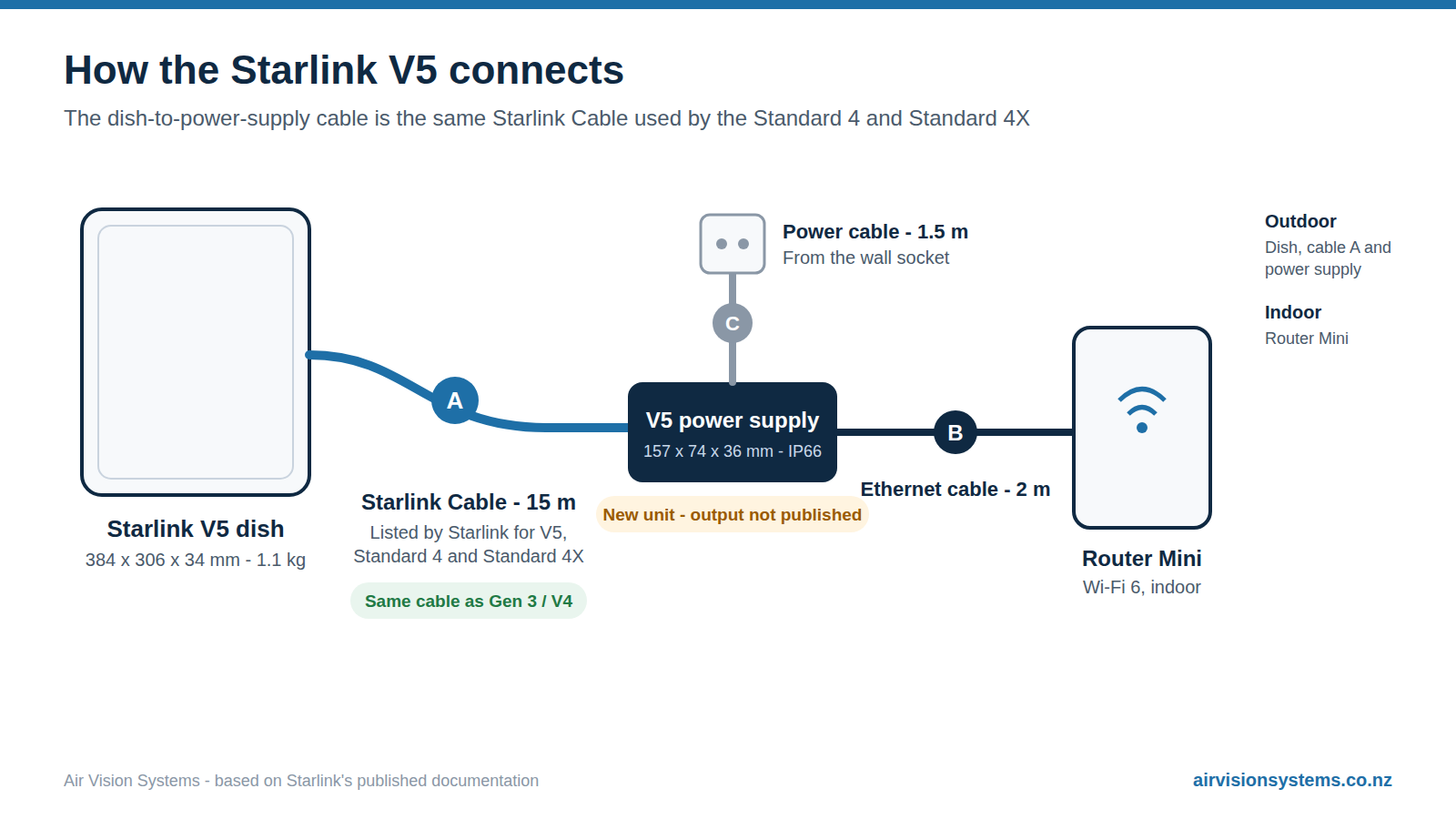
The Air Vision Systems 15 m Starlink Cable is built around the Standard 4 and Standard 4X (Gen 3 / V4) connector format. Starlink’s documents show the V5 uses the same official 15 m Starlink Cable format, and Air Vision Systems will update its cable range as V5 accessories become available. Browse the current range of Starlink cables. For longer runs on a V5, Standard 4 or 4X today, see the Starlink extension cables.
Mounting the Starlink V5: Pipe Adapter and Pole Sizes
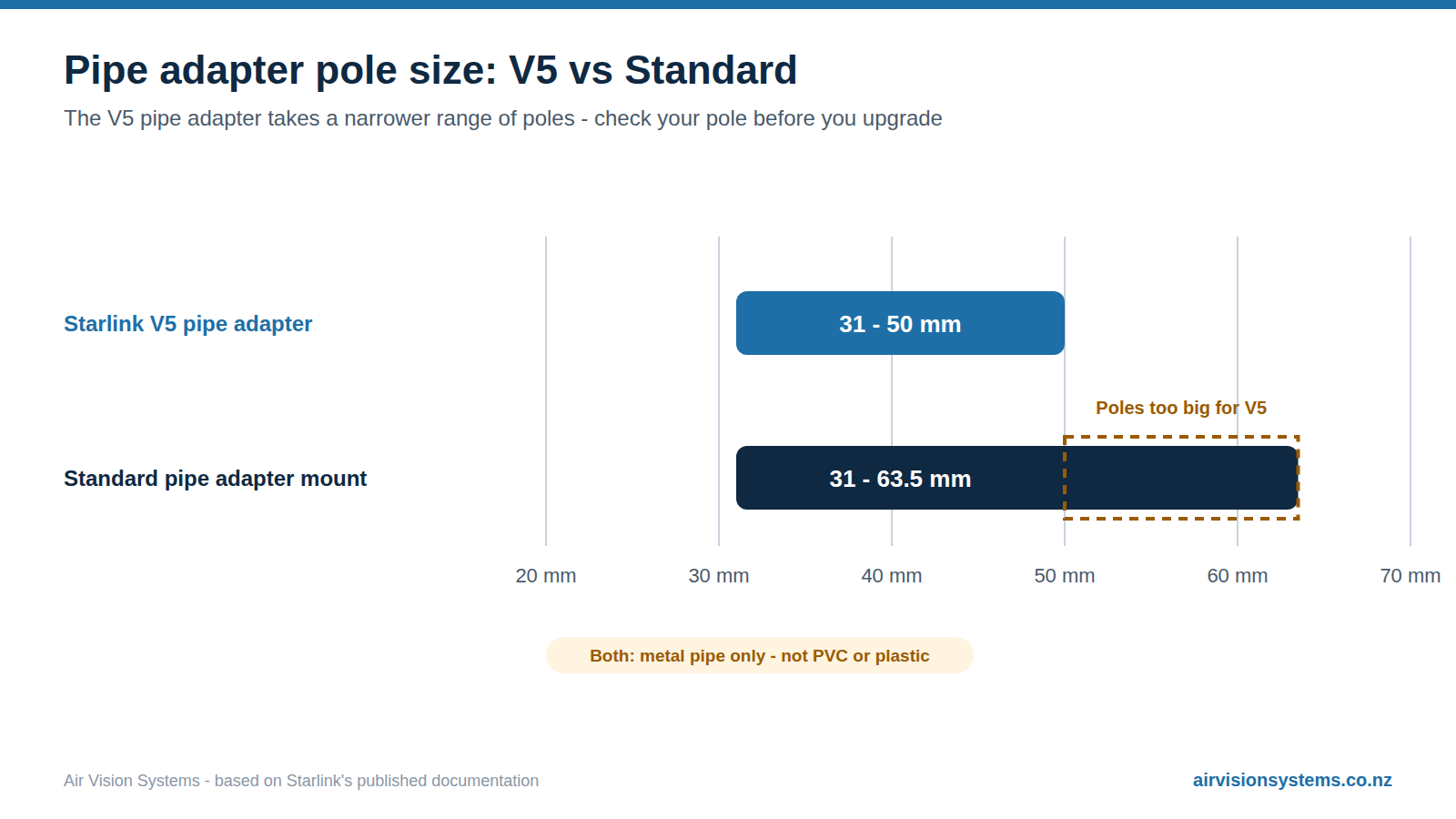
At 384 x 306 x 34 mm, against 594 x 383 x 39.7 mm for the Standard 4, the V5 needs its own mounts. It ships with a pipe adapter that fits metal poles from 31 mm to 50 mm in diameter. Starlink’s Standard pipe adapter mount takes poles from 31 mm to 63.5 mm, so an existing pole wider than 50 mm will not suit the V5 adapter. Both are for metal pipe only, not PVC or plastic.
Starlink also sells a Home Mount for the V5, which uses the included pipe adapter and can be fixed to vertical, sloped or flat surfaces. Air Vision Systems will update its V5 mount range as accessories become available in New Zealand and Australia. For the Standard 4 and 4X, see the Starlink pole mounts and wall mounts in the Gen 3 range.
FAQs
Common Questions
Helpful answers about choosing the right Starlink V5 accessories for your setup.
Is the Starlink V5 the same as the Starlink Mini?
No. They are easy to confuse by name, but the V5 is a fixed residential dish with a separate power supply and Router Mini, while the Mini is a portable, self-contained unit with a built-in router. They use different power systems, cables and mounting hardware.
Is the Starlink V5 the same as the Gen 3 / V4?
No. The Gen 3 / V4 is the dish in the Standard 4 and Standard 4X kits. Some people also call it Gen 4, but that is not a Starlink product name. The V5 is a newer, separate dish: 384 x 306 mm, against 594 x 383 mm for the Gen 3 / V4. Check the size before you buy a mount or cover.
Is the Starlink V5 in the Tesla Cybercab the same as the home V5?
No. Tesla and Starlink have shown a Starlink V5 built into the roof of Tesla’s Cybercab, but that is not the dish sold for homes. Independent research into Starlink’s firmware found a separate automotive revision of the V5. It is the same size as the home V5, but adds a satellite navigation (GPS) receiver, has 20 fewer antenna elements (800 against 820) and is built to tolerate more heat. Its internal name marks it as a prototype. According to the same research, the home V5 has no GPS receiver, which fits with Starlink’s statement that it is not intended for in-motion use. The automotive version is built into vehicles at the factory; it is not the dish you would buy for a campervan or boat. For Starlink on the move, Starlink supports the Mini and the Standard 4 on eligible plans.
Will my existing Gen 3 or V4 cables work with the Starlink V5?
Yes, for the official dish cables. Starlink lists its 15 m and 45 m Starlink Cables as compatible with the V5, Standard 4 and Standard 4X, and both specification sheets show the same connector and wiring. Physical mounts and covers built for the Gen 3 dish shape are not expected to fit, since the V5 dish is a different size.
Will my Standard mounts fit the Starlink V5?
Not directly. The V5 uses its own mounting interface and includes a pipe adapter for 31 mm to 50 mm metal poles. An existing metal pole within that diameter range may be reusable, but Standard 4/4X dish-specific mounts, adapters and covers should not be assumed to fit the V5 without a V5-specific interface or confirmed adapter.
Is the Starlink V5 faster than the Standard 4X?
Not necessarily. Starlink lists peak hardware capability of 375+ Mbps for the V5 and 400+ Mbps for the V4/Standard dish. The V5’s main advantages are its much smaller size, lower weight and lower power consumption. Starlink notes that these are peak hardware figures; actual speeds vary with service plan, location, availability and network conditions.
When will the Starlink V5 be available in New Zealand and Australia?
There is no confirmed date yet. As of 24 September 2026, Starlink is advertising V5 in selected areas of the United States and says it will reach additional areas as production increases. No V5 launch announcement or V5 ordering option has been found for New Zealand or Australia. Check this page for updates, or check a specific address directly in the Starlink ordering flow.
How much power does the Starlink V5 use, and can it be run from 12 V?
Starlink lists average power consumption of 35 to 50 W, roughly half the 75 to 100 W of the Standard 4, which makes it attractive for off-grid, solar and battery systems. Starlink’s current public V5 specification sheet does not state the power supply’s DC output rating, so Air Vision Systems does not recommend any 12 V or third-party PoE setup for the V5 until compatibility has been confirmed.
Will Air Vision Systems stock mounts and covers for the Starlink V5?
Air Vision Systems will update its range as V5 mounts and covers become available in New Zealand and Australia.