

If your vehicle has a fibreglass roof, a no-drill Starlink mini roof mount is the only realistic option. The conventional approach means drilling through the roof, and for campervan hire companies, motorhome owners, and long-haul truck operators, that is not acceptable. Composite roofs are expensive to repair. And once a hole is in, it is in.
This no-drill Starlink roof mount setup uses the Air Vision Systems Starlink Mini Mount, an Aluminium 5052 bracket, installed on fibreglass without drilling using a dual-adhesive bonding system in place of fasteners. Structural acrylic foam tape forms the primary layer and structural glazing-grade silicone forms the secondary, bonding the mount directly to the fibreglass roof without a single fastener penetrating the substrate. No drill. No fasteners penetrating the roof. No warranty void.
But the question operators always ask is: will it stay on at highway speed, in crosswinds, through a storm? We did not answer that with a brochure claim. We answered it with a Fluid-Structure Interaction simulation running Category 5 equivalent wind conditions across three yaw angles, 0 degrees, 45 degrees, and 90 degrees, on a fibreglass roof substrate. The result was a Factor of Safety of 32.0 at the adhesive interface, with global deformation remaining negligible throughout.
This post walks through the engineering behind that result, and explains why it matters for every operator who needs Starlink on a fibreglass roof without compromising the vehicle beneath it.
Why Fibreglass Roofs Change the Mounting Equation
Steel roofs tolerate drilling. A sealed bolt through steel sheet is a routine installation: the material is forgiving, corrosion-resistant fixings are widely available, and the structural consequence of a small penetration is negligible.
Fibreglass is a different story. Drill through a fibreglass panel and you introduce a stress concentration point into a laminate that was never designed for it. Water ingress follows. Delamination starts at the penetration and works outward, invisibly, until the damage becomes visible, by which point it is expensive to reverse. For a motorhome or campervan, that can mean panel replacement. For a hire fleet operator, it means downtime, repair cost, and a potential insurance complication every time a vehicle goes out with a roof penetration that was not factory-specified.
Long-haul truck operators face a related problem. Cab roofs on modern European and Japanese trucks are increasingly composite or fibreglass-skinned. Aerodynamic fairings, sleeper pod panels, and integrated roof systems are not designed to be drilled in the field. The manufacturer warranty position on post-sale roof penetrations is rarely favourable.
This bonded installation method sidesteps all of this. By bonding the Air Vision Systems Starlink Mini Mount directly to the fibreglass surface using a dual-adhesive system, the mount transfers aerodynamic loads into the substrate through shear and peel, the same load paths that fibreglass handles naturally, rather than concentrating force at a fastener point. And because the Air Vision Systems Starlink Mini Mount is formed from Aluminium 5052, a material roughly seven times stiffer than fibreglass, and powder coated for durability, it distributes those loads across the full adhesive interface rather than allowing the bracket itself to flex and concentrate stress at the bond edges.
The Dual-Adhesive Bonding System: How It Works
Most adhesive mount systems rely on a single bonding layer. This installation method for the Air Vision Systems Starlink Mini Mount uses two, and the distinction matters under real-world operating conditions.
The primary layer is a structural acrylic foam tape, the same class of adhesive used in automotive assembly and unitised facade systems on modern skyscrapers. It is selected for its high shear strength and its ability to release cleanly under heat at end of life, which is what makes the system viable for rental fleets and lease vehicles where clean removal at resale matters.
Applied across the full contact footprint of the mount base, it provides immediate, high-strength adhesion from the moment of installation. On a moving vehicle, road vibration, thermal expansion and contraction, and the constant low-frequency oscillation of highway driving are all absorbed at this layer rather than transmitted as peel stress into the fibreglass substrate.
The secondary layer is a structural glazing-grade silicone sealant, the same class of adhesive used to bond glass panels into the facades of modern buildings. It is applied above the tape to bond the mount frame to the tape layer, providing a flexible, weather-resistant interface that absorbs the differential movement and thermal cycling a vehicle roof experiences over time. Where the tape handles the primary mechanical load, the silicone provides a weatherproof barrier and a secondary adhesive reserve. If the primary layer were ever to experience localised stress concentration at an edge, the most common failure initiation point in bonded assemblies, the silicone perimeter contains it.
Air Vision Systems does not publish the specific brand or product line for either layer. The system has been engineered and tested as a matched pair, and publishing exact specifications would make it straightforward for other suppliers to reverse engineer the solution without doing the underlying engineering work. Full specification, including product names and application parameters, is available under NDA to distributors, wholesale partners, fleet operators, and installers with a legitimate requirement. Contact Air Vision Systems to request access.
Together, the two layers create a bonded interface with two independent failure modes that must both be overcome simultaneously for the mount to detach. Because the Aluminium 5052 bracket is exceptionally rigid under aerodynamic loading, it distributes stress across the full adhesive footprint rather than concentrating it at the bond edges. In the FSI simulation, the equivalent stress across the combined adhesive interface peaked at just 0.0151 MPa under Category 5 equivalent wind loading at 275 km/h. The most conservative material limit within the joint sits at 0.48 MPa, giving a minimum Factor of Safety of 32.0 across the bonded system as a whole.
The aluminium construction is not incidental to that result. It is the reason the adhesive interface is so lightly loaded even under extreme conditions.
Testing the No-Drill Starlink Roof Mount at Category 5 Wind Loads on Fibreglass
A mount on a moving vehicle does not just face wind from the front. At highway speed, a truck or motorhome encountering a crosswind, overtaking another vehicle, or navigating an exposed motorway interchange is subjected to aerodynamic loading from multiple directions simultaneously. The simulation was designed to reflect that reality.
The Fluid-Structure Interaction analysis subjected the bonded mount assembly to a wind speed of 275 km/h, Category 5 equivalent conditions, across three yaw angles. The finite element model was developed in ANSYS Mechanical, with all adhesive interfaces modelled using bonded contact definitions and large deformation effects enabled to accurately capture adhesive behaviour. At 0 degrees the airflow struck the mount head-on, replicating the worst-case forward travel loading. At 90 degrees the flow was broadside, simulating a direct crosswind. At 45 degrees the flow came from the quartering angle, and this proved to be the most demanding case, generating a peak total pressure of 8,170 Pa localised at the forward corner of the mount.
For context, 275 km/h represents wind conditions that cause widespread structural destruction at a landscape level. A vehicle travelling at highway speed in the most severe storm conditions New Zealand or Australia is likely to produce will not come close to generating equivalent aerodynamic loads on a roof-mounted device.
The substrate modelled throughout was fibreglass, matching the roof material of campervans, motorhomes, and composite-cabbed trucks directly. The fibreglass roof panel was assigned the material properties of standard chopped strand and woven composite panels, with a tensile elastic modulus of 10,000 MPa. The mounting bracket was modelled as Aluminium 5052, with a tensile elastic modulus of 70,000 MPa, matching the actual material of the Air Vision Systems Starlink Mini Mount.
This seven-fold difference in stiffness between the bracket and the roof substrate is not just a material specification. It is what drives the exceptional Factor of Safety the simulation returns, because a rigid aluminium bracket under aerodynamic load distributes stress across the adhesive interface far more evenly than a compliant fibreglass one would.
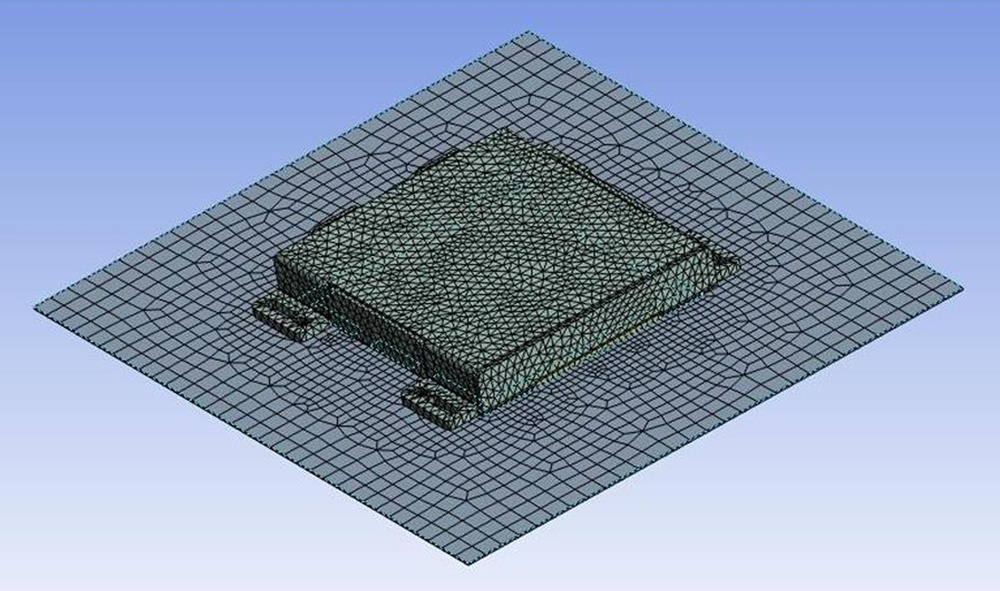
Figure 1: Multi-domain FSI mesh showing the bonded mount assembly on the fibreglass roof substrate
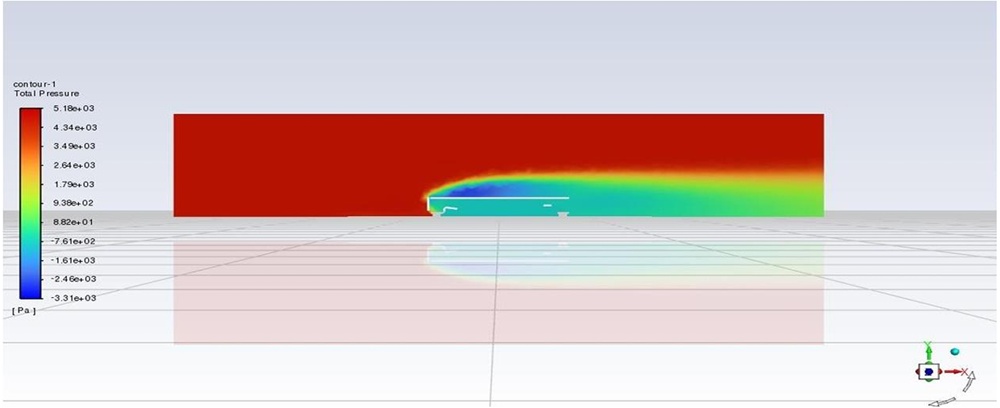
Figure 2: CFD total pressure contour at 0 degree yaw (head-on loading), maximum total pressure 5,180 Pa
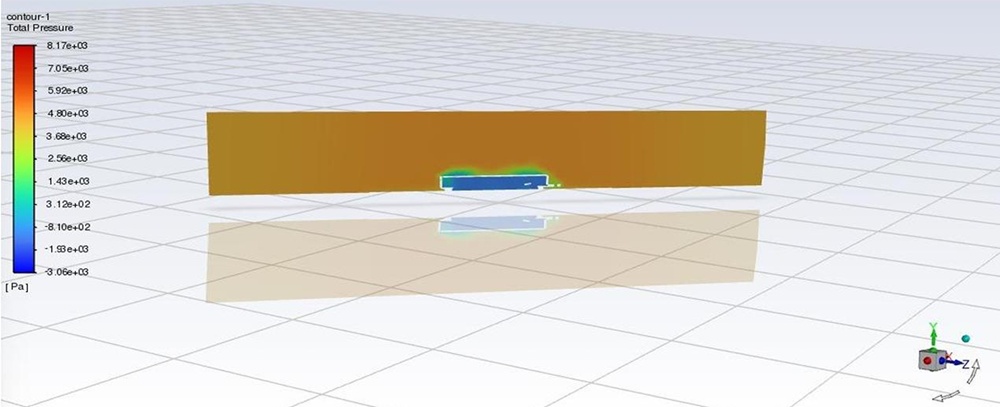
Figure 3: CFD total pressure contour at 45 degree yaw (quartering wind), peak pressure 8,170 Pa at the forward corner
Engineering Verified: Aluminium 5052 Mount, 275 km/h on Fibreglass Roof
The Air Vision Systems Starlink Mini Mount, an Aluminium 5052 bracket installed using this bonded method, has been assessed under a one-way Fluid-Structure Interaction simulation at Category 5 equivalent wind speeds of 275 km/h across three yaw angles on a fibreglass roof substrate. The peak Maximum Principal Stress recorded at the adhesive interface was 0.0151 MPa, against a conservative material limit of 0.48 MPa, delivering a minimum Factor of Safety of 32.0. No drilling. No fasteners. No roof penetration.
What the Results Show: Stress, Deformation and Factor of Safety
Under head-on loading at 0 degrees yaw, the mount assembly exhibited a maximum global deformation of just 0.0216 mm. The adhesive layers absorbed the differential strain, recording an equivalent stress of 0.0085 MPa, a fraction of the material limit and well within the elastic range of both bonding materials. At this load case the Aluminium 5052 bracket is, in engineering terms, barely registering the wind load at all. Its stiffness is doing the structural work, leaving the adhesive interface essentially unstressed.
The governing case for the adhesive assessment was the 90 degree broadside angle, where the Maximum Principal Stress in the adhesive interface reached its bounding value of 0.0151 MPa within the DOWSIL 795 sealant. Even at this bounding load case, the stress is so far below the material limit that the result reframes what “demanding” means for this system. The aluminium bracket distributes aerodynamic loading so evenly across the bonded footprint that neither the pressure concentration at the forward corner nor the broadside loading translates into meaningful stress at the adhesive interface. The 45 degree quartering angle, which generated the highest localised pressure of 8,170 Pa at the forward corner, produced a nearly identical equivalent stress of 0.0150 MPa in the adhesive interface.
Comparing the bounding adhesive stress of 0.0151 MPa against the most conservative material limit within the bonded joint, the 3M VHB 5952 normal tensile limit of 0.48 MPa, yields a minimum Factor of Safety of 32.0. For context, a Factor of Safety above 2.0 is considered robust for a bonded assembly under dynamic loading. A Factor of Safety of 32.0 means the adhesive interface can withstand nearly 32 times the stress actually recorded before approaching its failure threshold.
That result is not primarily a property of the adhesive. It is a direct consequence of the Aluminium 5052 bracket construction, which is rigid enough under aerodynamic load that it transfers stress into the roof substrate rather than concentrating it at the bond line.
Global deformation across the assembly remained negligible throughout all three load cases, peaking at just 0.0520 mm under 45 degree quartering wind. The Aluminium 5052 mount itself reached a peak equivalent stress of 5.97 MPa under that same load case, against a yield strength of 193 MPa, giving a structural Factor of Safety of 32.3 for the bracket itself. The simulation confirms that under Category 5 equivalent wind loading, neither the mount nor the adhesive interface is anywhere near its material limits.
For fleet operators, these numbers translate to a straightforward assurance: a correctly installed Air Vision Systems Starlink Mini Mount, bonded to a fibreglass roof using this method, will not detach under highway operating conditions, crosswind exposure, or severe weather events. The engineering margin is not tight. It is exceptional. This mirrors the approach we have taken across our wider range of Starlink mounts. Our Air Vision Systems Starlink Gen 3 Mount has been through its own full CFD and FEA assessment, tested to 252 km/h Category 5 hurricane conditions across plywood, steel, and concrete foundations, returning a minimum Factor of Safety above 7.
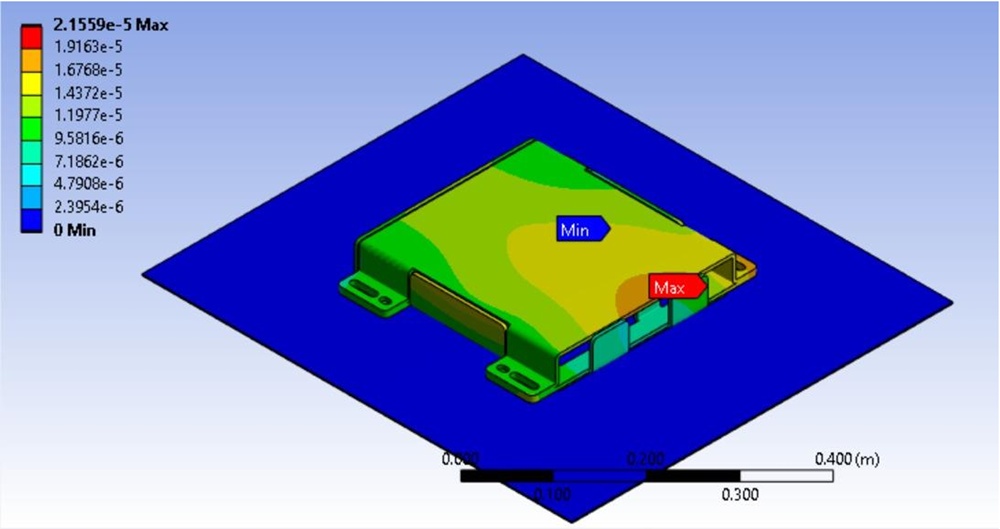
Figure 4: FEA total deformation plot at 0 degree yaw, maximum global deformation 0.0216 mm across the Aluminium 5052 mount and fibreglass roof assembly
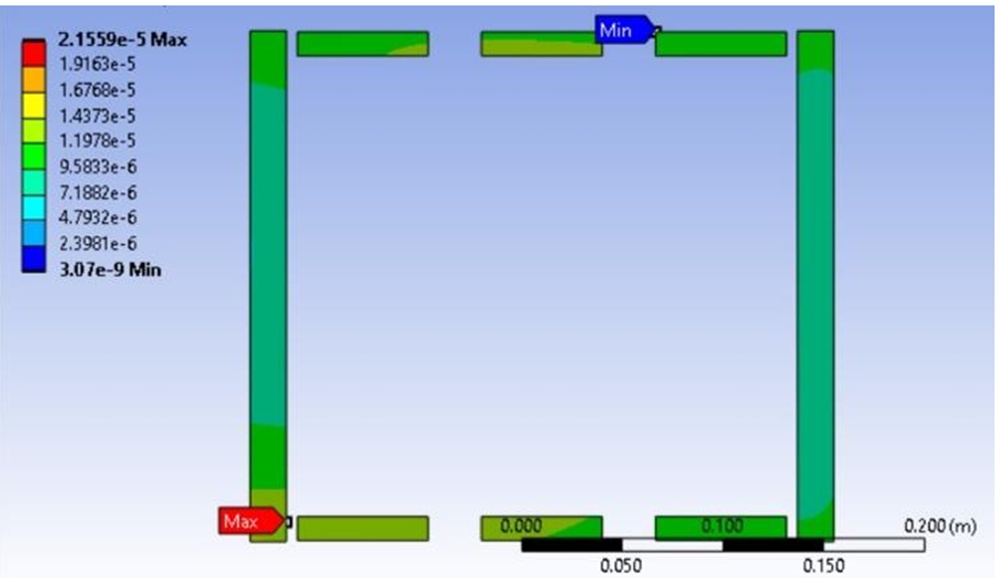
Figure 5: FEA equivalent stress on the adhesive interface under bounding load case (90 degree yaw), peak 0.0151 MPa, Factor of Safety 32.0
The Air Vision Systems Starlink Mini Mount can be bonded directly to fibreglass and composite roofs: campervans, motorhomes, and commercial vehicles. No roof penetration, no lease complications, and no specialist installation equipment required. Contact Air Vision Systems for installation guidance specific to this bonded fitment method. View the Air Vision Systems Starlink Mini Mount.
Who This Mount Is Built For: Fleet Applications and Operator Requirements
Campervan and motorhome hire companies operate under a straightforward constraint: the vehicles are assets, and the roof cannot be compromised. A drilled penetration affects the asset value of every vehicle it is on, creating a potential water ingress point that can lead to delamination and costly panel repair. For a hire fleet, that means downtime and repair cost that a no-drill installation avoids entirely. When the time comes to sell the vehicle or upgrade equipment, the mount can be removed cleanly or left in place as a Starlink-ready feature that adds value rather than raising questions.
Long-haul truck and wagon operators face a different but related requirement. Connectivity on extended interstate or inter-island runs is increasingly an operational necessity rather than a convenience, for driver communications, fleet tracking integration, and passenger amenity on shuttle and coach operations. The roof mount needs to survive the full range of conditions those routes produce: exposed high-country highways, coastal runs with direct crosswind exposure, and the constant vibration loading of long-distance sealed and unsealed road surfaces. The dual-adhesive system handles vibration loads through the compliance of the primary tape layer, which absorbs rather than transmits road-induced oscillation.
Emergency services, mining support vehicles, and utility fleets share a common requirement with both groups above: the mount must work without specialist installation infrastructure. Remote deployment means the vehicle may be fitted in the field, far from a workshop. The Air Vision Systems Starlink Mini Mount, bonded using this method, is designed for exactly that: surface preparation, correct adhesive application, and the mount is positioned and secure. The Aluminium 5052 construction means the bracket itself contributes to the structural integrity of the installation, rather than relying on the adhesive alone to compensate for bracket flex under load.
Installation Requirements: Surface Preparation and What Correct Fitment Looks Like
The engineering results in this report are predicated on one critical assumption: that the bonded interface is correctly prepared before the adhesive is applied. A Factor of Safety of 32.0 is the result of a clean, properly prepared fibreglass surface.
Surface preparation is straightforward but non-negotiable. The roof area where the mount will be bonded must be clean, dry, and free of wax, polish, road grime, and any existing sealant residue. An isopropyl alcohol wipe-down immediately before application is the minimum requirement. Any surface contamination that remains between the adhesive layer and the fibreglass panel reduces the effective contact area and degrades the bond strength the simulation assumes.
The mount base should be positioned and aligned before the adhesive is committed. Once the primary tape layer makes contact with the prepared surface, repositioning is not practical. Take the time to confirm dish orientation, cable routing, and clearance from roof features before final placement.
The structural silicone secondary layer is applied around the perimeter of the mount base after the primary tape bond is made. This layer requires a full cure period before the vehicle returns to heavy-duty service. In normal temperature and humidity conditions that process completes well within a standard working day for handling strength, with full cure achieved over the following weeks during normal operation.
For fleet operators where vehicle turnaround time is a priority, two-part structural silicone is worth considering as an alternative to the single-component product specified in this report. Two-part silicone cures by chemical reaction rather than atmospheric moisture, reaching handling strength in as little as 30 minutes. The tradeoff is that it requires a dual-cartridge dispensing gun and a disciplined mixing process. Contact Air Vision Systems if you would like guidance on suitable alternatives for your specific fitment program.
The Air Vision Systems Starlink Mini Mount comes with standard fitting instructions, but this bonded, no-drill method is a specialised application. Contact Air Vision Systems directly, whether you’re fitting a single vehicle or a fleet, and we can walk you through the surface preparation and bonding process for your specific vehicle roof specification.
Frequently Asked Questions
Will the bonded mount work on a curved fibreglass roof?
The mount base is designed to conform to the mild curvature typical of campervan and motorhome roofs. The structural silicone secondary layer accommodates minor surface irregularities, ensuring full perimeter contact. For roofs with pronounced curvature, contact Air Vision Systems before fitting to confirm suitability.
How do I prepare the roof surface before bonding the Air Vision Systems Starlink Mini Mount?
The surface must be clean, dry, and free of wax, polish, road grime, and any existing sealant residue. An isopropyl alcohol wipe-down immediately before application is the minimum requirement. Correct surface preparation is critical: the Factor of Safety of 32.0 confirmed in the engineering simulation assumes a properly prepared bonding surface.
Can the mount be removed without damaging the fibreglass roof?
Yes. The dual-adhesive system bonds to the surface without penetrating it, meaning removal leaves the roof structurally intact. When the time comes to remove the mount, whether for vehicle sale or equipment upgrade, the roof can be restored cleanly, or the mount left in place as a Starlink-ready feature.
What wind speed was the no-drill Starlink mini roof mount tested to on a fibreglass substrate?
The mount was assessed under a Fluid-Structure Interaction simulation at 275 km/h, Category 5 equivalent wind conditions, across three yaw angles. The peak adhesive stress recorded was 0.0151 MPa against a material limit of 0.48 MPa, giving a minimum Factor of Safety of 32.0.
Does this bonded installation method work for Starlink Gen 3 as well as Starlink Mini?
This bonded installation method has been engineered and tested for the Air Vision Systems Starlink Mini Mount. If you are running Starlink Gen 3 on a commercial vehicle, contact Air Vision Systems to discuss the correct mounting solution for your application.
What tape and silicone are used to bond the Air Vision Systems Starlink Mini Mount?
The primary layer is a structural acrylic foam tape, the same class of adhesive used in automotive assembly and unitised facade systems on modern skyscrapers. The secondary layer is a structural glazing-grade silicone sealant, the same class used to bond glass panels into building facades. Air Vision Systems does not publish the specific brand or product line for either material, as the engineering behind the system, not just the components themselves, is what makes it work. Full specification is available under NDA to distributors, wholesale partners, fleet operators, and installers with a legitimate requirement. Contact Air Vision Systems to request access.
What is the difference between one-part and two-part structural silicone for installation?
The one-part structural silicone specified in the engineering report cures by absorbing atmospheric moisture. It reaches handling strength within 24 to 48 hours and achieves full cure over several weeks during normal operation. Two-part structural silicone cures by chemical reaction between a base and catalyst, reaching handling strength in as little as 30 minutes, a significant advantage for fleet operators with tight vehicle turnaround requirements. Two-part silicone requires a dual-cartridge dispensing gun and careful attention to mixing ratio. Both systems deliver equivalent structural performance when correctly applied. Contact Air Vision Systems for guidance on the best option for your fitment program.
What the Engineering Tells Us
A fibreglass roof is not a barrier to Starlink connectivity. It just requires a different approach to mounting. Drilling is not that approach. It introduces stress concentrations into a laminate that was never designed for penetrations, creates water ingress risk, and leaves a permanent mark on an asset that may need to be sold, hired, or redeployed.
This no-drill Starlink roof mount approach was engineered to solve this problem at the level it deserves, not with a marketing claim, but with a Fluid-Structure Interaction simulation running Category 5 equivalent wind conditions on a fibreglass substrate. The result is an Air Vision Systems Starlink Mini Mount that holds with a Factor of Safety of 32.0 at the adhesive interface under 275 km/h loading, across all three aerodynamically demanding yaw angles, with negligible global deformation throughout.
For campervan hire fleets, motorhome owners, long-haul truck operators, and any commercial operator running vehicles with composite or fibreglass roofs, that is the assurance the installation requires. No drill. No penetration. No compromise on structural integrity.
Fit Starlink to Your Fibreglass Roof Without Drilling
The Air Vision Systems Starlink Mini Mount can be bonded to fibreglass and is in stock now, shipping fast across New Zealand and Australia. This bonded fitment method isn’t covered by the standard instructions, so contact the Air Vision Systems team directly for guidance on surface preparation and bonding.
Sorting your cable and power setup at the same time? The Air Vision Systems Smart Cable Calculator will work out the right combination for your install in under a minute.
View the Air Vision Systems Starlink Mini Mount. Use the Air Vision Systems Smart Cable Calculator.