
Based on engineering analysis commissioned by Air Vision Systems | NZ, AU and Global
The AVS Starlink Generation 3 Clip-In Pole Adapter attaches to a pole you supply yourself. That could be from a hardware store, a fabricator, or something you’ve already got on site. So before you go and buy one, I want to walk you through choosing the right pole, based on the engineering we’ve done behind the adapter.
Why a 248 km/h Gust Isn’t Twice as Bad as 124 km/h, It’s Four Times Worse
Wind pressure does not increase in a straight line with wind speed. It increases with the square of velocity. That means doubling the wind speed from 124 km/h to 248 km/h does not double the pressure on your Starlink mount, it quadruples it.
The CFD analysis behind the AVS Starlink Gen 3 mount range recorded a maximum pressure of 32,346 Pa on a 3,000 mm pole at 248 km/h, more than four times the 7,567 Pa recorded on a 300 mm pole at the same wind speed. It is not just the wind that matters. It is the pole you choose, and how well it is specified, that determines how much of that force your mount has to handle.
248 km/h is Wellington’s recorded maximum wind speed, and it’s what we test every AVS Gen 3 mount against. This is why I always tell people to get the pole right before they buy, it matters more than most installers expect.
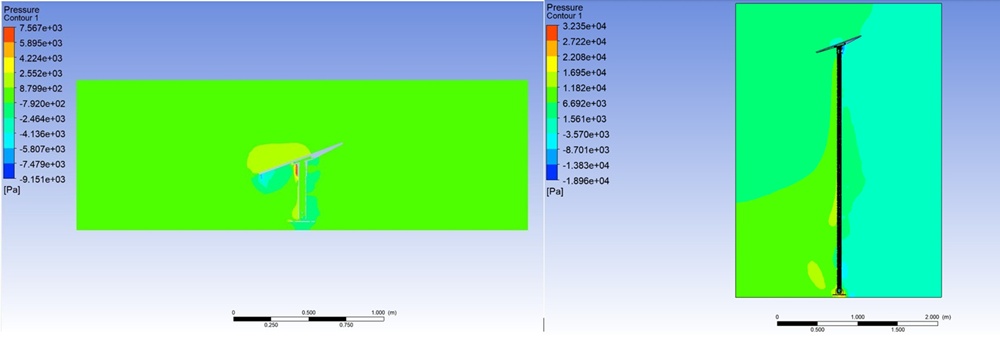
CFD pressure comparison, 300mm vs 3000mm pole at 248 km/h. Source: Air Vision Systems Compliance Pack 2025
The Engineering Behind the Recommendation
That fourfold pressure increase above is not an estimate. It is the direct result of dynamic pressure scaling with the square of wind speed, confirmed by both CFD simulation and independent hand calculation against Wellington’s recorded maximum wind speed.
The Checklist for Choosing the Right Pole
The AVS Starlink Generation 3 Clip-In Pole Adapter is a heavy-duty black powder-coated aluminium bracket, fitting pole sizes from 37 mm to 51 mm. Before you buy or source a pole, run through these four checks.
1. Confirm your minimum pole length first. Use the Starlink app’s obstruction tool to find the minimum height needed for a clear, unobstructed 110-degree cone of sky at your install location. That number, not aesthetics or convenience, should drive everything that follows.
2. Match wall thickness to that length. As a guide, 3 mm wall thickness suits pole lengths up to 500 to 600 mm in sheltered conditions, 4 mm suits 600 to 700 mm in moderate exposure, and 5 mm is what I’d recommend for anything longer, or for any site that is coastal, elevated, or anywhere in Wellington, regardless of length.
3. Confirm the outer diameter falls within 37 mm to 51 mm. This is the compatible range for the AVS Clip-In Pole Adapter. A pole outside this range will not fit the bracket correctly, regardless of how well-specified the wall thickness is.
4. Check the wall thickness is consistent along the full length. A pole that is rated 5 mm at the base but tapers or thins further up will not perform to the same standard as one that holds a consistent wall thickness throughout. Ask your supplier to confirm this directly rather than assuming it from the base measurement.
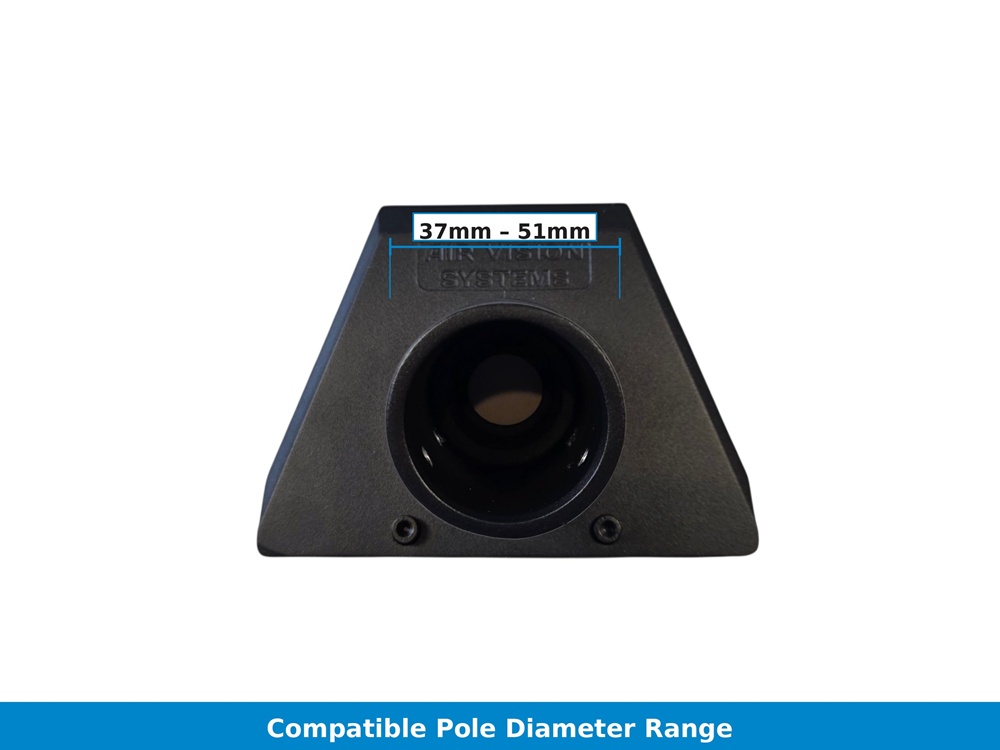
AVS Starlink Gen 3 Clip-In Pole Adapter, compatible with pole diameters from 37mm to 51mm
What Happens If You Get It Wrong
The consequence of an undersized pole is not subtle. The FEA testing behind the AVS Gen 3 mount range found that a 300 mm pole, correctly specified, produced just 15.5 mm of total deformation at 248 km/h, a small, manageable deflection well within safe limits.
A 3,000 mm pole under the same wind conditions does not fare the same way. The CFD analysis already showed the pressure on a 3,000 mm pole running more than four times higher than on a 300 mm pole. Add pole length into the equation and the bending moment compounds that further, since a longer pole gives the wind load a much longer lever arm to work with. The structural margin that a short, well-specified pole comfortably holds onto simply is not there once you stretch the pole length and get the wall thickness wrong.
Wall thickness and outer diameter are not interchangeable specifications. A pole that fits the bracket but is undersized on wall thickness for its length and site exposure is still a non-compliant installation. The fit confirms the adapter will physically attach. The wall thickness confirms it will hold under load.
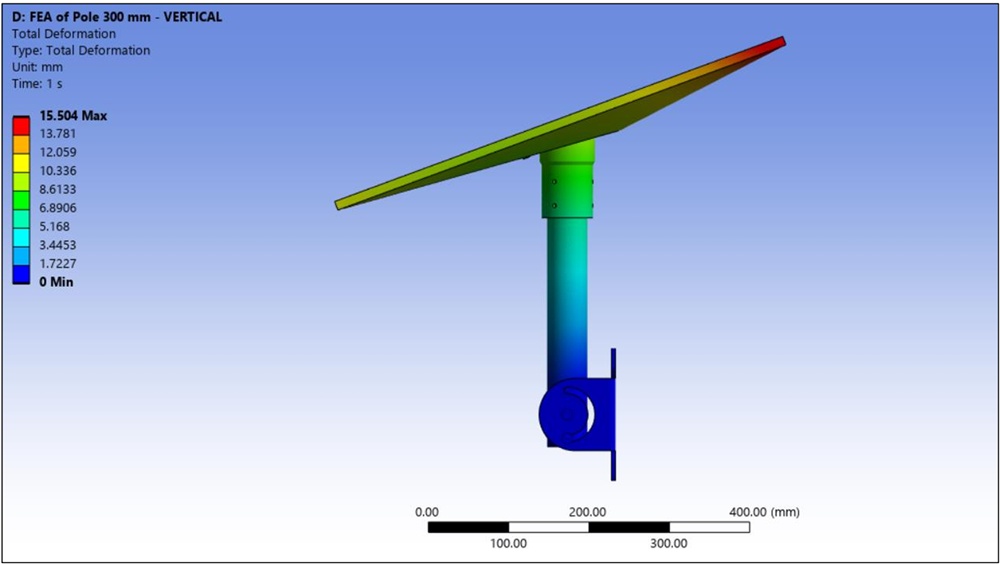
FEA total deformation analysis, 300mm pole at 248 km/h. Source: Air Vision Systems Compliance Pack 2025
Get It Right the First Time
Four checks. Minimum length from the obstruction tool, wall thickness matched to that length, outer diameter between 37 mm and 51 mm, and consistent wall thickness along the full pole. Get those four right before you buy, and the AVS Starlink Gen 3 Clip-In Pole Adapter does the rest.
Frequently Asked Questions
What pole diameter does the AVS Starlink Gen 3 Clip-In Pole Adapter fit?
The adapter fits pole sizes from 37 mm to 51 mm outer diameter. Confirm your pole falls within this range before purchasing, regardless of wall thickness or length.
Can I use any pole as long as it fits the bracket?
No. Fit and structural performance are two separate requirements. A pole within the 37 mm to 51 mm range will physically attach to the adapter, but it also needs the correct wall thickness for its length and site exposure to perform safely under wind load. Both checks matter.
Do I need an engineer to approve my pole and mount installation?
For most standard residential installs, a pole specified to the correct diameter, wall thickness, and length is sufficient. For commercial installs, exposed sites, or anywhere local council consent may be required, having a structural engineering analysis on file is valuable. The Air Vision Systems Compliance Pack 2025 provides exactly that, a documented engineering reference you can include with any consent application.
Where do I buy a pole that meets these specifications?
We don’t supply the pole itself. Poles are typically sourced from a hardware supplier, a metal fabricator, or an existing structure on site. Use the checklist above to confirm specification before purchasing and check out the AVS Starlink Gen 3 Clip-In Pole Adapter product page for the confirmed compatible diameter range.
What the Engineering Tells Us
Once you’ve got the right pole, the AVS Starlink Generation 3 Clip-In Pole Adapter is the bracket I’ve had engineered and tested to handle it. Cast from heavy-duty aluminium, tested to 248 km/h, and backed by a full CFD and FEA structural assessment.