
Electrical Engineer (PEC Registered) | Air Vision Systems Compliance Pack 2025 | NZ and AU
If you are spending time in a vehicle, whether that is a ute, campervan, caravan, or work truck, and you want to run Starlink Mini on the go, the first thing most people reach for is the cigarette lighter socket. It is right there, it is easy, and it seems like an obvious solution. But whether it actually works depends on which converter you are using, how long your cable run is, and whether your vehicle socket is rated for the job.
The good news is that running Starlink Mini from a cigarette lighter is absolutely possible with the right converter. The not-so-good news is that not all converters are created equal, and the difference between a 60W unit and a 105W unit has a real impact on how far you can safely run your cable. It also matters whether you are talking about a Starlink Mini or a Gen 3, because the Gen 3 draws significantly more current and should not be connected to a cigarette lighter socket at all.
This post is based on a formal engineering review prepared for Air Vision Systems, covering two specific cigarette lighter DC converter products and their suitability for powering Starlink Mini in vehicle environments. For a full breakdown of vehicle cable run limits and step-up converter sizing, see our guide on how far you can run a Starlink Mini cable in a vehicle.
Why Cigarette Lighters Work for Starlink Mini (But Not Gen 3)
Before getting into the converters themselves, it is worth understanding why the cigarette lighter question has a different answer depending on which Starlink terminal you have.
The Starlink Mini draws between 20 and 40 watts in normal operation. At 12V, that works out to roughly 3.3 amps at full load, well within the current rating of most vehicle cigarette lighter sockets, which are typically rated between 10 and 15 amps continuous. So with the right converter doing the voltage step-up to 30V, the Mini is a good fit for cigarette lighter power.
The Starlink Gen 3 is a completely different story. It draws up to 100 watts, and at 12V that means approximately 15 to 16 amps from the source, which exceeds most cigarette lighter socket ratings before you have even accounted for cable losses or startup transients. Running a 57V step-up converter for the Gen 3 through a cigarette lighter socket risks overloading the socket, blowing the vehicle fuse, or causing overheating in the wiring.
The engineering review is clear on this point: the Gen 3 should use direct battery wiring or an Anderson connector input, not a cigarette lighter socket. For the Mini, a cigarette lighter connection is acceptable provided the vehicle socket is rated for at least 10 amps and the right converter is used.
The Two Converters Reviewed and How They Differ
The engineering review assessed two specific cigarette lighter DC converter products for Starlink Mini use. Both output 30V DC and use an inline DC-DC step-up converter, but they differ in power rating and that difference has real consequences for cable length.
Product A: 60W Converter
Product A is a compact unit with an integrated step-up converter located mid-cable, a cigarette lighter plug with strain relief, and a male DC barrel output connector. It outputs 30V DC at up to 2 amps, a maximum of 60 watts. This lower output current is actually an advantage when it comes to cable runs, because lower current means less resistive voltage drop per metre of cable.
Product B: 105W Converter
Product B is a more capable unit with a separate finned aluminium converter housing, a solid metal cigarette lighter plug with spring contacts, and a 16 AWG input pigtail stepping up to an 18 AWG output cable. It outputs 30V DC at up to 3.5 amps, 105 watts maximum. The higher power rating gives more headroom above the Mini’s 40W draw, but the increased output current makes it more sensitive to cable length.
Both products use standard automotive-grade construction, moulded strain reliefs, and appropriate connector types. The engineering review confirmed both are electrically sound and appropriately designed for Starlink Mini use. The key difference comes down to how far you can run the cable from each one.
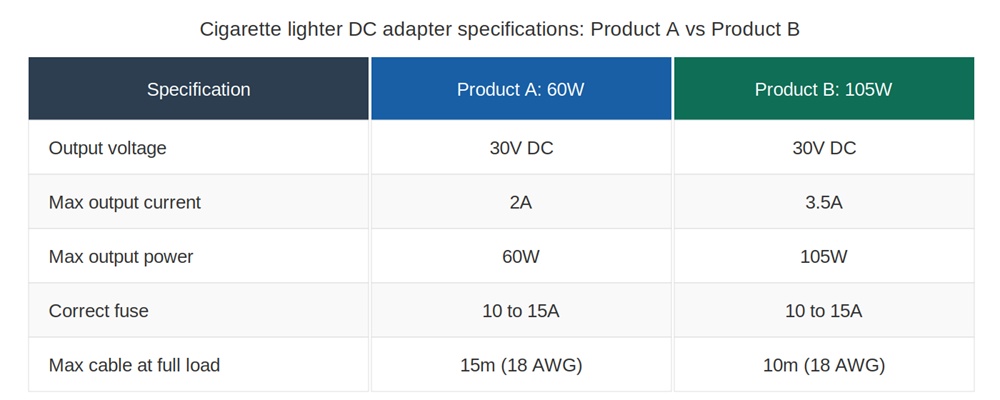
Figure 1: Specifications comparison for Product A (60W) and Product B (105W) cigarette lighter DC converters reviewed for Starlink Mini.
How Far Can You Run the Cable? Product A vs Product B
Cable length limits are not arbitrary. They are calculated from the voltage drop along the cable at a given current. The more current flowing, the shorter the safe run.
Product A (60W): Cable Length Limits
At its maximum rated output, Product A delivers up to 2 amps at 30V through an 18 AWG output cable. The engineering review validated the following lengths:
3 metres: fully compliant
5 metres: fully compliant
10 metres: acceptable and stable
15 metres: electrically viable, upper practical limit at full rated load
Beyond 15 metres at maximum load, thicker conductors would be required to maintain compliance.
Product B (105W): Cable Length Limits
Product B delivers up to 3.5 amps at 30V, a meaningfully higher current that increases sensitivity to cable resistance. At this power level the validated limits are tighter:
3 metres: fully compliant
5 metres: fully compliant
10 metres: maximum recommended length at full rated load
Beyond 10 metres: not recommended with 18 AWG output cable
If you need to run Product B beyond 10 metres, upgrading the output cable to 16 AWG makes longer runs feasible.
The Real-World Picture for Starlink Mini
Both converters are rated for more power than the Starlink Mini actually draws. The Mini typically operates at 20 to 40 watts, well below the maximum output of either converter. At those lower power levels, output current drops significantly, which means voltage drop along the cable drops too. Under real Starlink Mini operating conditions, both Product A and Product B can support approximately 40 to 60 metres of 18 AWG output cable, a very different number to the conservative full-load limits above. For a vehicle install where the Mini is the load, the longer figures are the more relevant reference.
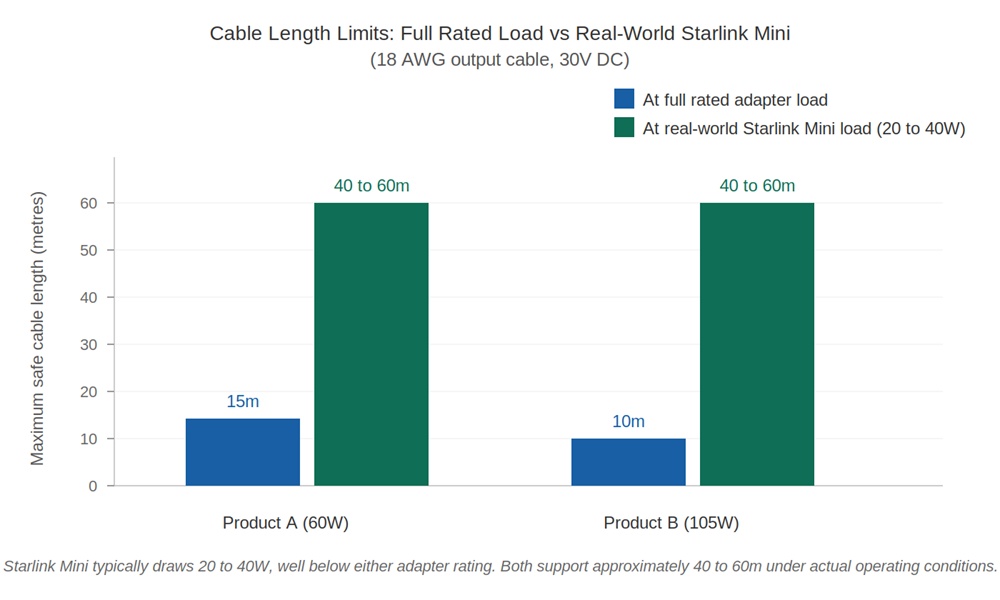
Figure 2: Maximum safe cable lengths at full rated converter load versus real-world Starlink Mini operating conditions (20 to 40W). Both converters support significantly longer runs under actual Mini load.
Fuse Sizing: Why It Matters and What to Use
Fuse sizing is one of the most overlooked steps in any vehicle DC installation and getting it wrong can cause real problems even if the system appears to work fine in normal use. The purpose of a fuse is to protect the cable, not just the device. An oversized fuse will not blow before the cable overheats in a fault condition.
The engineering review specifies a 10 amp or 15 amp input fuse for both converters when used with Starlink Mini. Both Product A and Product B are supplied with a 15 amp fuse fitted, which is within the acceptable range for the cable gauges used in these products and the current draw of the Starlink Mini under full load.
Automotive cigarette lighter sockets are typically rated 10 to 15 amps continuous, and neither converter requires more than 15 amps input current even under full load including conversion losses and startup transients.
The correct fuse ratings for cigarette lighter DC converters powering Starlink Mini are:
Product A (60W): 10 to 15 amp input fuse
Product B (105W): 10 to 15 amp input fuse
One installation rule applies regardless of which converter you use: fit the fuse as close to the battery or vehicle fuse box as practical. A fuse located at the far end of a cable run does not protect the cable between the battery and the fuse, which is exactly the section most likely to be damaged in a fault.
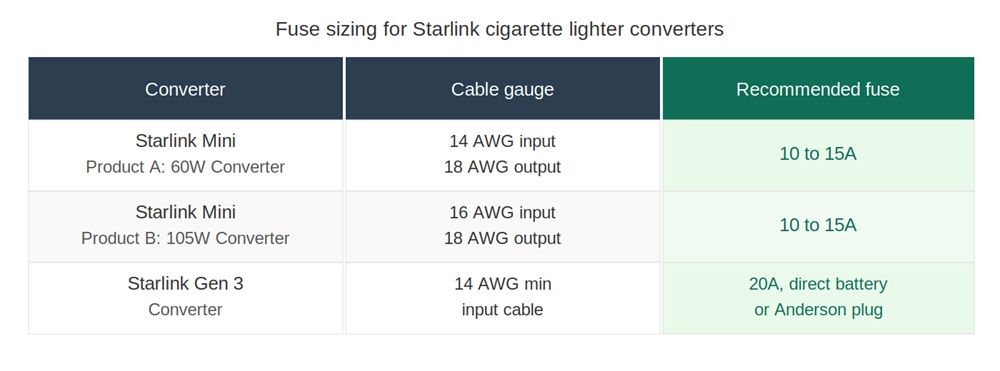
Figure 3: Fuse sizing reference for Starlink Mini and Gen 3 cigarette lighter converters
Converter Placement and Why the Architecture Matters
Both converters reviewed place the DC-DC step-up converter close to the 12V source, meaning close to the cigarette lighter plug end, not at the Starlink Mini end. This is the correct design and it matters more than most people realise.
The 12V side of the circuit carries the highest current. At 12V input with a 40W load and 90% converter efficiency, approximately 3.7 amps are being drawn through the input wiring. That current creates resistive losses and heat in the cable. By placing the converter early in the circuit, right at the cigarette lighter plug, the high-current section is kept as short as possible. From the converter output onward, the voltage is 30V, the current drops to around 1.3 amps, and the cable can do its job efficiently over a much longer run.
Why Direct 12V Supply to the Starlink Mini Does Not Work
If the converter were placed at the Starlink Mini end instead, 12V at high current would be running all the way to the dish, which would require much heavier cable gauge and would cause significant voltage drop along the way. The closer-to-source placement is what makes the cable length limits in the previous section achievable.
This is also why the engineering review flagged direct 12V supply to the Starlink Mini without a converter as non-compliant beyond 2 to 3 metres. The Mini needs at least 20V to operate, and 12V with any meaningful cable run falls below that threshold before you have gone anywhere.
A 20 amp fuse will not protect your vehicle wiring in a Starlink Mini power setup. It is simply too large for the cable gauge used in most cigarette lighter DC converters. The correct fuse for both a 60W and a 105W Starlink Mini converter is 10 to 15 amps. Sizing the fuse to protect the cable, not just the device, is one of the most overlooked safety steps in any vehicle DC installation, and it is completely straightforward once you know the right numbers.
Air Vision Systems stocks DC power converters specified and reviewed to the exact engineering standards covered in this post, the right output voltage, the right fuse rating, and the right cable gauge for your vehicle install. Browse the full range at Air Vision Systems Power Supplies and Cables.
Frequently Asked Questions
Can I run Starlink Mini from a cigarette lighter socket?
Yes, with the right DC converter. The Starlink Mini draws 20 to 40 watts in normal operation, which is well within the current rating of most vehicle cigarette lighter sockets. You need a 12V to 30V step-up converter with the correct fuse rating, 10 to 15 amps for both a 60W and a 105W unit.
Can I run Starlink Gen 3 from a cigarette lighter socket?
No. The Gen 3 draws up to 100 watts, which means approximately 15 to 16 amps at 12V, more than most cigarette lighter sockets can safely handle. The Gen 3 requires direct battery wiring or an Anderson connector input for safe vehicle operation.
How long can my cable run be from a cigarette lighter converter to the Starlink Mini?
At full rated converter load, Product A (60W) supports up to 15 metres and Product B (105W) supports up to 10 metres on 18 AWG cable. Under real Starlink Mini operating conditions of 20 to 40 watts, both converters can support approximately 40 to 60 metres of 18 AWG cable, which covers the vast majority of vehicle installs.
What fuse should I use with a Starlink cigarette lighter converter?
Use a 10 to 15 amp fuse for both a 60W and a 105W converter. A 20 amp fuse is too large for the cable gauge used in these products and will not protect your wiring in a fault. Always fit the fuse as close to the battery or vehicle fuse box as possible.
Does it matter where the step-up converter sits in the cable?
Yes. The converter should always be positioned close to the 12V source, meaning near the cigarette lighter plug end, not the dish end. This keeps the high-current 12V section of the circuit as short as possible, reducing voltage drop and heat in the input wiring.
If you want to run the numbers for your specific vehicle install, different cable lengths, gauges, or voltages, the AVS Smart Cable Calculator does the hard work for you. It is built on the same engineering methodology behind this report, so you can plug in your setup and get a compliant result without doing the maths by hand.
Try it here: AVS Starlink Smart Cable Calculator
The Right Converter Makes All the Difference
Running Starlink Mini from a cigarette lighter is a practical and engineered solution for vehicle installs, provided you use the right converter, the correct fuse, and keep your cable run within the validated limits. The 60W converter gives you more flexibility on cable length at full rated load, while the 105W unit offers more power headroom above the Mini’s draw. Under real-world Starlink Mini operating conditions, both converters support cable runs of 40 to 60 metres on 18 AWG cable, more than enough for any vehicle installation.
The findings in this post come from a formal engineering review prepared for Air Vision Systems covering electrical safety, voltage drop behaviour, fuse sizing, and connector suitability for cigarette lighter DC converter products. The same engineering series behind our full Starlink cable compliance reports, so the numbers are consistent across the board.
If you are planning a vehicle Starlink Mini install and want to make sure you have the right converter and cable for your setup, use the AVS Starlink Smart Cable Calculator to check your specific run length, or browse the full Air Vision Systems power supply range for compatible converters.
Not sure how to measure your cable route before ordering? Our guide on what length Starlink cable you need walks you through the process step by step.
Browse the full AVS power supply range at Air Vision Systems Power Supplies or use our free AVS Starlink Smart Cable Calculator to find the exact spec for your run length.